Upgrading Public Welfare Engagement Mechanisms in the Digital Era through Business Interaction Innovation
February 2026 · San Francisco
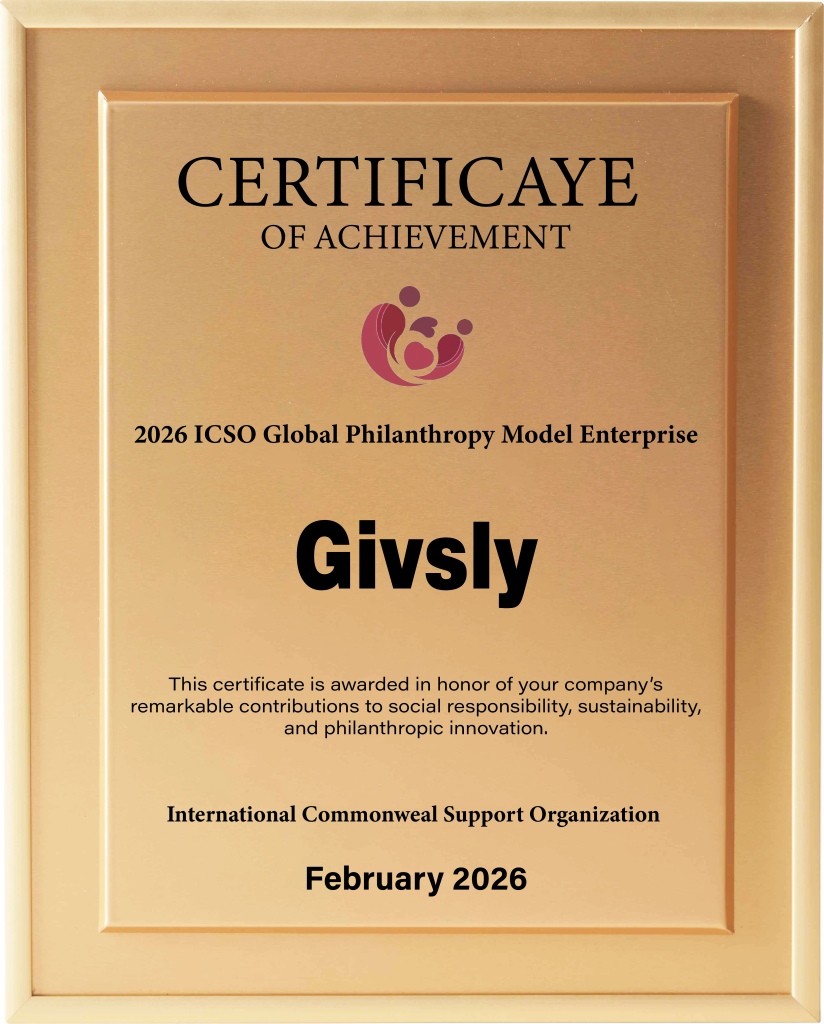
The International Civil Society Organization (ICSO) has officially announced that Givsly, a U.S.-based social impact technology company, has been awarded the 2026 “Global Exemplary Philanthropic Enterprise” distinction. Established by the ICSO, this award aims to recognize corporate entities that demonstrate outstanding innovation, long-term social responsibility awareness, and the continuous capacity to create public value within the global philanthropic sector.
Following months of rigorous evaluation and multiple rounds of comprehensive deliberation by an international judging panel, Givsly stood out among numerous global candidates. The recognition comes in honor of its novel mechanism that transforms business meetings, advertising interactions, and corporate marketing activities into charitable donations, as well as its sustained social impact in supporting the growth of non-profit organizations. The judging panel noted that Givsly breaks away from traditional corporate philanthropy models that rely solely on one-way donations. By establishing an innovative pathway of “business activities as public welfare engagement,” Givsly enables daily commercial activities to continuously generate social value, offering a representative and innovative paradigm for corporate philanthropic practices in the digital age. This initiative—mobilizing philanthropic resources through mechanism innovation—aligns seamlessly with ICSO’s core philosophy of “long-termism and systemic social value creation.”
Integrating Business and Public Welfare: Transforming Daily Commercial Actions into Long-Term Social Value
In traditional philanthropic systems, corporate donations and commercial operations often exist independently. Givsly, however, seeks to redefine the relationship between the two. Powered by its digital platform mechanism, commercial actions—such as watching advertisements, booking business meetings, and participating in brand interactions—automatically trigger charitable donations to non-profit organizations. The significance of this model lies in shifting philanthropy from an “extra activity” to a natural, integrated element of the commercial process. Users contribute philanthropic funds to designated social organizations simply by booking a meeting or interacting with an ad. As a result, public welfare engagement is no longer confined to occasional large-scale charity events, but instead becomes an ongoing practice within the daily business ecosystem.
The judging panel highlighted that this mechanical innovation effectively increases the frequency and scope of public welfare participation. A vast volume of commercial interactions that previously had no direct path into the philanthropic ecosystem can now be converted into social value via the platform mechanism, forming a new route for resource flow. Companies not only enhance the social responsibility attributes of their business partnerships, but non-profit organizations also gain a more stable and diversified source of support. The model established by Givsly fundamentally redesigns the relationship between business and society within the context of the digital economy, fostering a tighter synergistic structure between commercial growth and social value creation.

Digital Platform Capabilities: Enhancing Resource Connection Efficiency through Technology
As a company driving social innovation through platform capabilities, one of Givsly’s core strengths in philanthropic practice lies in its highly efficient digital resource connection mechanism. By connecting brands, advertisers, business professionals, and non-profit organizations through its platform, Givsly facilitates the flow of philanthropic resources in a more transparent, efficient, and cost-effective manner. Under this framework, non-profits no longer rely exclusively on traditional fundraising channels; instead, they receive continuous support through commercial collaborations. Meanwhile, brand enterprises fulfill their social responsibility initiatives seamlessly during marketing campaigns, and everyday business users gain opportunities to engage in charitable acts as part of their routine activities. Through this multi-party collaborative mechanism, Givsly has built a digital philanthropy network that bridges the divide between business and public welfare.
The significance of this platform model extends beyond the technology itself; it changes how philanthropic resources are allocated. By optimizing mechanism design, the platform enhances both the convenience and sustainability of charitable engagement, allowing social value creation to embed itself more deeply within the digital commercial ecosystem. Furthermore, Givsly utilizes data tracking and transparency mechanisms to continuously record the flow of philanthropic funds and project outcomes, thereby strengthening trust among enterprises and the public. This governance approach—combining institutional structure with data transparency—provides the platform’s philanthropy model with greater long-term stability.
Social Impact Mechanism: Driving Corporate Responsibility from Donations to Participatory Governance
As global concepts of Corporate Social Responsibility (CSR) continue to evolve, an increasing number of organizations are shifting their focus toward “participatory philanthropy” rather than pure financial donations. Givsly’s practices embody this growing trend. Through structural mechanism design, the company enables brands, employees, business partners, and consumers to participate together in the philanthropic process, thereby establishing a broader network of social collaboration. In several partnership cases, corporate clients did not merely deliver financial support through the platform; they also actively engaged in non-profit advocacy, social issue awareness campaigns, and community project collaborations. This transition from “financial funding” to “participatory collaboration” allows philanthropic actions to generate a deeper level of social impact.
The judging panel concluded that Givsly’s most innovative aspect lies in transforming social responsibility from a one-way corporate output into a multi-stakeholder process of shared value creation. By combining digital platforms with business mechanisms, the company reactivates the public value potential inherent in commercial activity and offers a new direction for the future of corporate philanthropy. The public welfare model established by Givsly demonstrates a sustainable path that balances commercial development with social value creation.

Judges’ Citation: Reshaping Corporate Philanthropy through Mechanism Innovation
In its official statement, the ICSO International Judging Panel remarked: “Givsly has demonstrated highly forward-looking innovation in the global corporate philanthropy sector. By leveraging digital platforms and business interaction mechanisms, it converts traditional charitable giving into high-frequency, sustainable, and broadly participatory acts of social value creation, establishing a novel model for corporate social responsibility practices in the digital era.”
The panel further noted that Givsly’s contribution goes beyond the scale of financial support; it lies in enhancing engagement efficiency through mechanism innovation and guiding corporate philanthropy from one-way giving toward collaborative governance. This model of deeply embedding social value into commercial behavior aligns closely with the principle of “institutionalized philanthropy and long-term social impact” championed by the ICSO.
This honor serves not only as significant recognition of Givsly’s long-term exploration in innovative philanthropic mechanisms, but also marks a new phase of development for corporate philanthropy in the digital business era. The ICSO believes that, as the digital economy and social responsibility become increasingly integrated, innovative companies like Givsly are injecting fresh vitality into the global philanthropic ecosystem and steering corporate social responsibility away from traditional donation models toward a more open, diversified, and sustainable path forward.