A Long-Term Architect of a Global, Collaborative Community Philanthropy System
April 2025 — New York
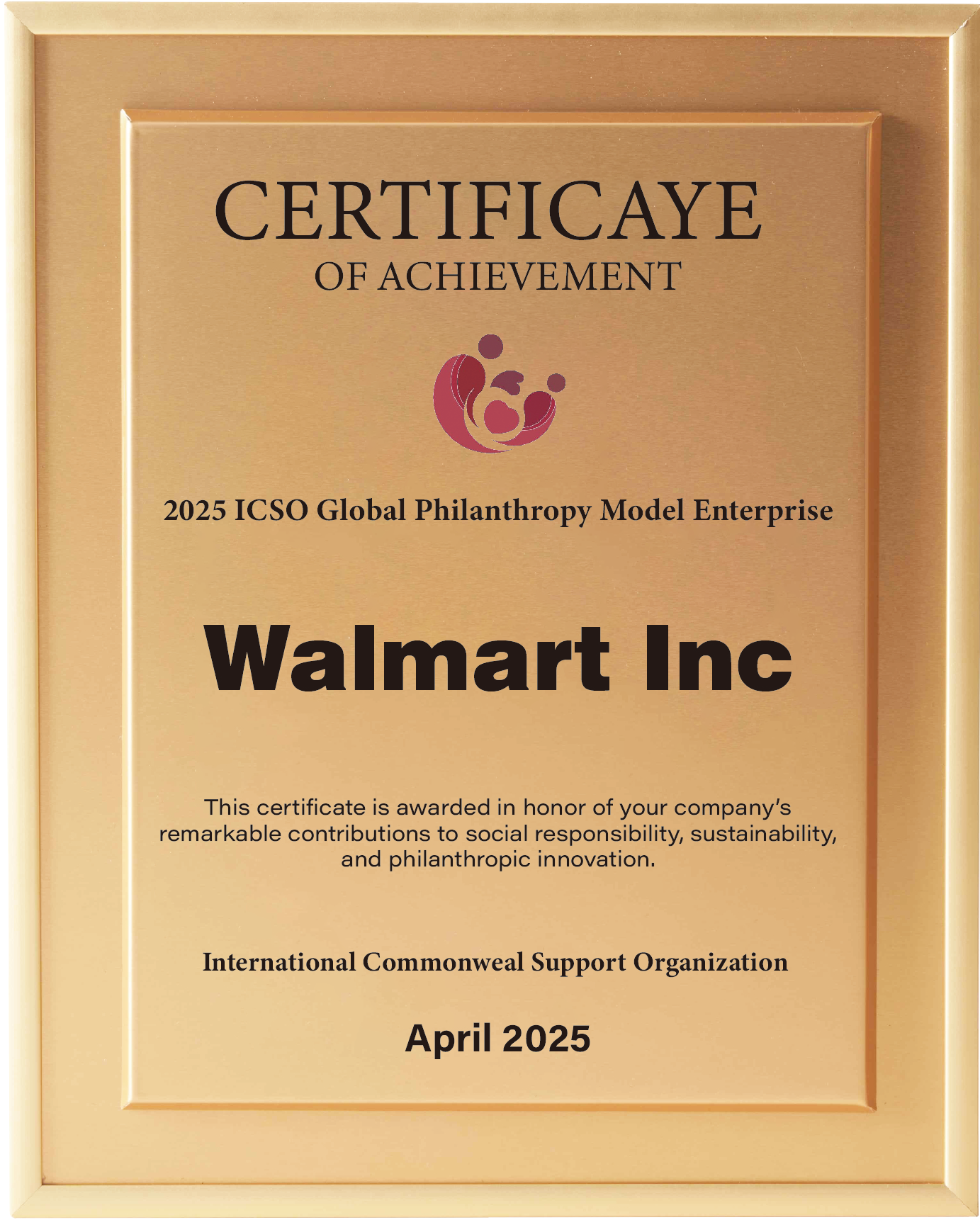
The International Commonweal Support Organization (ICSO) has officially announced that Walmart Inc., a landmark enterprise in the global retail industry, has been awarded the 2025 “Global Model Enterprise for Philanthropy” Award in recognition of its sustained and systematic contributions to education support, community development, equitable allocation of philanthropic resources, and the advancement of social well-being worldwide. This distinction represents the highest institutional honor conferred annually by ICSO, designed to recognize international organizations that promote long-term public value through structured social responsibility practices and generate broad, cross-regional social impact.
The selection process was conducted by an independent international jury composed of experts in public policy, international philanthropy management, community development, and sustainable business. Following multiple rounds of nomination review, comparative evaluation, and in-depth case analysis, Walmart distinguished itself from a global pool of candidates through its transregional philanthropic foundation system, comprehensive school support networks, nonprofit collaboration mechanisms, and community capacity-building models.
According to the jury, Walmart’s philanthropic architecture has moved well beyond traditional donation-based approaches. Instead, it has evolved into an integrated ecosystem encompassing resource coordination, capacity enhancement, civic participation, and long-term operational stability—positioning the company as a pivotal corporate actor in global public governance and social development.
Community Philanthropy Systems: Building a Sustainable Social Support Framework Through Scale
Walmart has consistently regarded local communities as the foundation of its social value creation strategy. Across North America and other regions, the company has established multidimensional support systems spanning education, food security, emergency relief, and local economic development. Through the Walmart Foundation and a diverse set of community partnership mechanisms, the company provides large-scale financial assistance, in-kind donations, and operational support to schools, grassroots organizations, and nonprofit institutions each year—ensuring that philanthropic resources reach the community level and directly benefit ordinary families and vulnerable populations.
Compared with one-off or fragmented corporate philanthropy initiatives, Walmart’s community-based model demonstrates three defining characteristics. First, scalability: from food bank replenishment to student meal subsidies and campus support programs, Walmart’s philanthropic structures can be adapted and localized across states and regions with differing social and cultural contexts. Second, systemic continuity: rather than short-term or symbolic contributions, Walmart establishes long-term partnerships with community organizations to ensure sustained service delivery. Third, participatory integration: employees, community volunteers, and partner organizations together form localized action networks, embedding philanthropic engagement into everyday community life.
The ICSO jury noted that this framework positions Walmart as a representative “community capacity-building enterprise,” one that successfully transforms its organizational capabilities, logistics systems, and supply-chain strengths into durable public value within philanthropic contexts.

Education Support Networks: Advancing Structural Equity Beyond Financial Contributions
In the field of education, Walmart has long supported multi-tiered philanthropic initiatives spanning primary education, secondary schooling, vocational training, and adult learning. Its support mechanisms include scholarships, school infrastructure investments, teacher resource assistance, and targeted programs implemented in collaboration with nonprofit education organizations. Rather than focusing solely on funding volume, Walmart emphasizes the enhancement of access to opportunity, directly engaging in the distribution of educational resources to improve equity in learning environments, skill acquisition, and future employment pathways for disadvantaged groups.
Among its recent flagship initiatives, Walmart’s partnerships with community colleges have significantly expanded access to vocational education and skills training for local youth. Many program beneficiaries have successfully transitioned into local enterprises or public service sectors, creating a virtuous cycle linking education, employability, and community development. The jury highlighted this “education–skills–community development” triadic model as a critical mechanism through which large enterprises can promote long-term social well-being—one whose impact extends far beyond education itself, contributing to regional economic vitality and social stability.
ICSO further emphasized that Walmart’s most meaningful contribution in the education domain lies not in the scale of its financial investment, but in its sustained, structural commitment to improving educational access for underserved populations. This approach reflects a mature understanding of corporate participation in social governance, with philanthropic objectives clearly oriented toward long-term capacity building and equitable opportunity.

Philanthropic Collaboration Networks: Enhancing Public Value Allocation Through Cross-Sector Partnerships
Walmart has also developed extensive collaborative networks encompassing nonprofit organizations, local governments, school systems, and social service agencies. These networks play a critical role in disaster relief, food assistance, and emergency community support. Notably, in several large-scale regional disaster response efforts, Walmart has emerged as one of the earliest responders—leveraging its rapid-response mechanisms, supply-chain coordination, and distribution capabilities to deliver aid efficiently and at scale.
In terms of long-term cooperation, Walmart maintains stable strategic partnerships with numerous national-level nonprofit organizations. Through jointly established special-purpose funds, operational support structures, and coordinated project implementation, these partnerships enhance the governance capacity and execution quality of philanthropic initiatives. The jury observed that Walmart’s contribution extends beyond its own investments; more importantly, the company serves as a resource integrator within the philanthropic ecosystem—using its scale to improve overall system efficiency and optimize the allocation of limited social resources.
The establishment of this collaborative network illustrates an emerging model of corporate responsibility in public governance: large enterprises acting not only as participants, but as institutional facilitators of cross-sector coordination and collective impact.

Jury Citation: A Global Philanthropic Leader Transforming Scale into Social Well-Being
In its official award citation, ICSO stated:
“Walmart is not only a world-leading retail and supply-chain enterprise, but also a philanthropic actor that advances social well-being through systems-oriented governance thinking. Its long-term practices in education support, community development, emergency response infrastructure, and nonprofit capacity building have generated replicable and sustainable models of public value creation across regions, positioning Walmart as a central pillar within the global philanthropic ecosystem.”
ICSO expressed its anticipation of deeper collaboration with Walmart across future international philanthropic initiatives. As global public value demands become increasingly diverse—from educational access and inclusive social development to emergency preparedness and community resilience—Walmart’s accumulated experience across different regions offers valuable methodological insights for international philanthropic cooperation. ICSO firmly believes that as Walmart continues to expand its philanthropic reach, its influence will increasingly transcend traditional commercial boundaries, shaping a more forward-looking and resilient global philanthropy ecosystem through strategic, long-term action.