Setting an Industry Benchmark for Cross-Regional Social Value Creation Through Global Health Governance Practices
April 2025 · New York
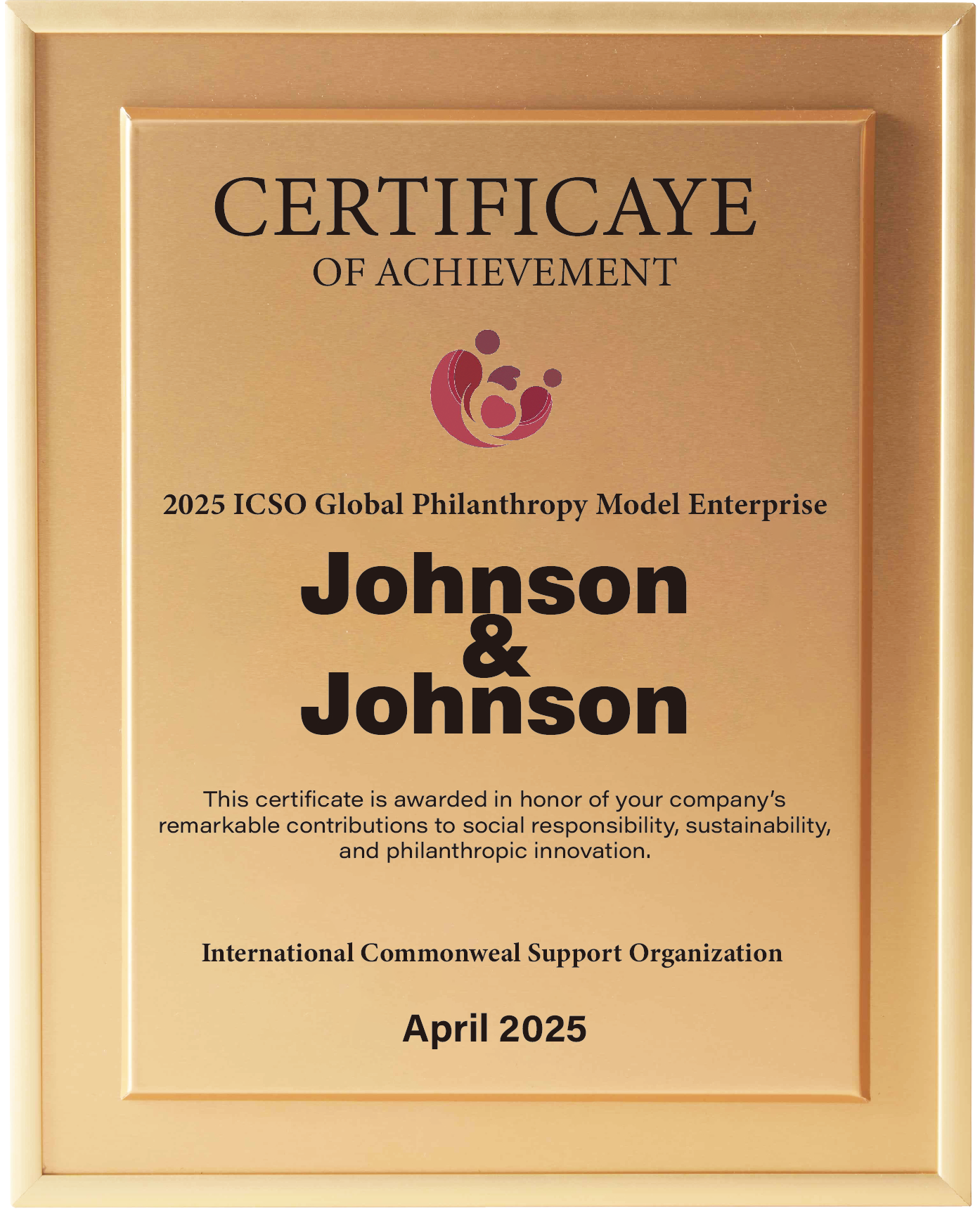
The International Council for Social Outreach (ICSO) formally announced that Johnson & Johnson, a global leader in the pharmaceutical and healthcare industry, has been awarded the 2025 “Global Philanthropic Model Enterprise” Award. As the highest annual honor conferred by ICSO upon global contributors to the public good, this award recognizes international organizations that advance public health through long-term strategic commitment, strengthen global health equity through systematic action, and demonstrate outstanding responsibility in building sustainable social impact.
The 2025 selection process was conducted by an international jury composed of experts in public health, sustainable development, social policy, and philanthropic management. Following multiple rounds of independent review, Johnson & Johnson distinguished itself among a competitive global field of candidates through its mature global health governance framework, cross-regional coordination mechanisms, sustained support for vulnerable populations, and deep innovation in public value creation. The selection committee emphasized that Johnson & Johnson has developed a philanthropic strategy with strong industry-demonstration value, providing essential structural support for the long-term, balanced development of the global public health ecosystem. This recognition not only affirms the company’s professional excellence and global responsibility, but also acknowledges its consistent integration of business value with social value—guided by science and human need to generate enduring global impact.
A Practitioner of Global Health Equity: From Frontline Care to Systemic Public Health Support
For decades, gaps in public health systems, unequal resource distribution, and barriers to healthcare access for vulnerable populations have remained central concerns of the international community. Johnson & Johnson has placed the advancement of global health equity at the core of its philanthropic strategy, implementing structured programs across multiple dimensions, including vaccine accessibility, frontline healthcare workforce support, community health education, and emergency public health response.
Across numerous regions, the company has established long-term partnerships with local public health authorities and multilateral organizations to jointly strengthen community hospital capacity, conduct health screenings, provide access to essential medicines, and deliver professional training for healthcare workers. In low-resource communities, for example, Johnson & Johnson has supported the development of sustained family health education systems and community volunteer networks, significantly improving access to childhood immunization, maternal and child health services, and chronic disease management.
The jury noted that this system-building approach to philanthropy goes beyond short-term relief. Instead, it reinforces local health safety nets through structural investment, transforming immediate support into long-term capacity and ensuring that philanthropic interventions rest on a sustainable foundation.
A Professional Path of Precision Health Intervention: Enhancing Philanthropic Impact Through Science
Across its health-focused philanthropic initiatives, Johnson & Johnson has established rigorous evaluation frameworks that measure key indicators such as disease prevention coverage, changes in medicine accessibility, health outcomes among vulnerable groups, and improvements in the skills of community healthcare providers. This results-oriented management approach ensures that programs deliver not only immediate outcomes, but also long-term feedback aligned with public policy standards.
Through collaborative research, cross-regional data tracking, and phased evaluation, the company continuously refines its strategies, enhancing both the precision and replicability of its philanthropic initiatives. Of particular note are Johnson & Johnson’s public health skills training programs for local youth in multiple regions. By combining structured curricula, hands-on training, and internships in grassroots medical institutions, these programs cultivate a cohort of health management professionals capable of serving their communities over the long term.
This model effectively addresses shortages in frontline healthcare capacity and establishes a self-sustaining cycle of local health capability development. It represents a meaningful extension of the company’s professional expertise into social value creation and stands as a significant contemporary paradigm in global medical philanthropy.

Multilateral Collaboration and a Sustainable Ecosystem: Strengthening the Flow of Health Resources
Johnson & Johnson’s philanthropic strategy is not pursued in isolation. Instead, it is embedded within a global collaborative framework that connects governments, international organizations, academic institutions, and civil society partners. From joint public health awareness campaigns with international bodies, to co-designed community health programs with national health ministries, to long-term monitoring initiatives with local NGOs, the company operates as a key node within the global public health governance system.
In regions facing elevated public health risks, Johnson & Johnson has also contributed to the development of regional emergency response mechanisms, including medical supply reserves, emergency training for healthcare professionals, and rapid response support networks—significantly improving preparedness and resilience in the face of sudden health crises.
At the same time, the company actively integrates sustainability principles into its philanthropic operations. Through green supply chains, low-emission operational models, and the use of environmentally responsible materials, Johnson & Johnson reduces the environmental footprint of its public health initiatives, aligning health philanthropy with broader sustainable development goals. The jury highlighted this holistic design as a forward-looking framework in which public health advancement and environmental responsibility reinforce one another.

Jury Citation: A Responsibility Model Guided by Science for the Future of Global Health
In its official citation, ICSO stated:
“Johnson & Johnson is not only a global leader in the pharmaceutical and healthcare sector, but also a responsibility-driven institution that advances human health through scientific rigor and participates in public governance from a truly global perspective. Its work in health equity, support for vulnerable populations, and healthcare system strengthening has set new benchmarks for the industry and injected long-term stability into the global public health ecosystem. Beyond improving the health outcomes of countless families, Johnson & Johnson has offered the international community a collaborative governance framework that is both replicable and scalable.”
The conferral of this award represents not only recognition of past achievements, but also an affirmation that the governance systems Johnson & Johnson has helped build in global health have become durable social infrastructure with lasting relevance.
Looking ahead, ICSO anticipates expanding collaboration with Johnson & Johnson across a broader range of public health issues, jointly exploring the role of enterprises as collaborative responsibility actors in global social governance. We firmly believe that health is not merely an individual right, but a shared global responsibility—and that the professionalism and commitment demonstrated by Johnson & Johnson are laying a stronger foundation for the future of global health systems worldwide.