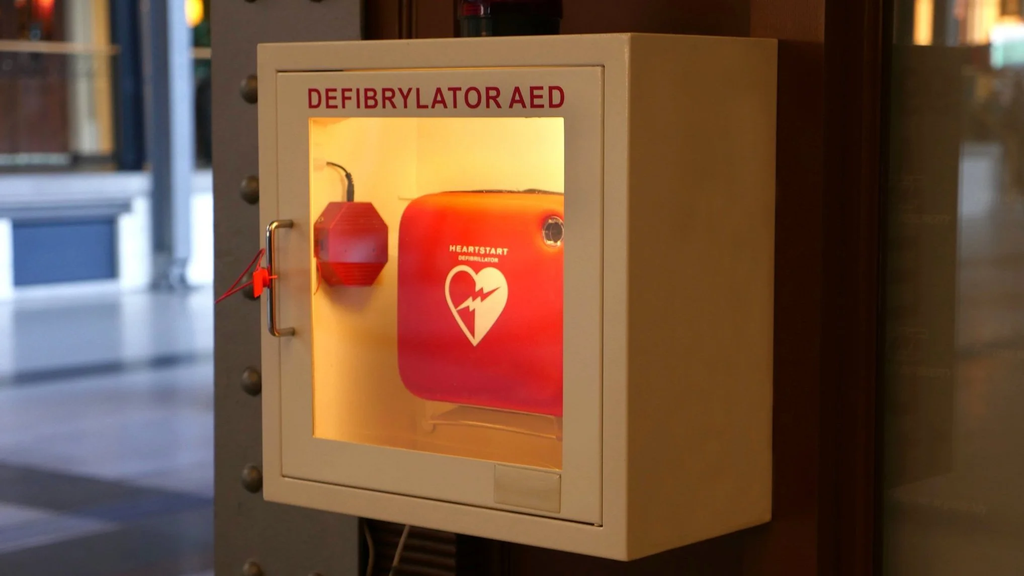
Many people pass by an AED every day, but few genuinely take note of where it is located. It might hang beside a library entrance, sit at the far end of a gymnasium corridor, or be mounted on a wall in a transit station, academic building, shopping mall, or community center. Resting inside its transparent cabinet, this compact device normally stays as quiet as a standard wall sign. Yet, during sudden cardiac arrest, athletic accidents, or public emergencies, it can become a vital tool to buy critical time for rescue.
First aid preparedness does not begin after an emergency strikes. Whether an AED location is clear, whether signs are prominent, whether the cabinet opens smoothly, whether the surrounding area is free of obstructions, and whether volunteers know how to call for emergency services and seek professional medical help—these seemingly minor details determine whether rapid action can be taken when every second counts.
As a youth volunteer, Emma Clarke has long been engaged in AED location inspections, emergency supply checks, prompt card organization, safety support at public events, and volunteer training assistance. Her contribution does not involve taking center stage to share dramatic stories; instead, through routine corridor walkthroughs, location logging, and emergency drills, she proactively builds readiness before emergencies arise.
Youth Volunteer
Profile Name: Emma Clarke Education: University of Manchester, Public Health-related major Affiliation: ICSO UK Branch

01 Discovering the Practical Significance of First Aid Readiness from a Gym Inspection
Emma’s first hands-on experience with the ICSO UK Branch Public First Aid Support Project occurred during a routine volunteer inspection at the university gymnasium. That day, the project team needed to verify several AED locations to confirm that the devices were in their designated spots, that external signage was clearly visible, that cabinet doors opened without obstruction, and that nearby pathways remained clear. She initially assumed this would be a simple task: find the device, take a photo to document it, and finish up after confirming no visible damage. However, after walking through the full inspection process, she realized that numerous subtle details directly affect response speeds in a crisis. One AED, though in its correct location, had its sign partially blocked by a temporary event poster; near another device, several boxes of sports equipment were stacked up, which could cause critical delays during an emergency if left uncleared.
The project coordinator explained to her that one of the core principles of public first aid is making equipment “visible, searchable, and accessible.” While the device itself is crucial, the surrounding environment, directional signage, and routine maintenance are equally vital. Standing in the gymnasium corridor and looking up at the AED sign on the wall, Emma realized for the first time that public first aid volunteer work is not just about mastering professional procedures—it is also about systematically identifying and resolving every detail that could impact a rescue beforehand. Following that inspection, she proactively joined the ICSO UK Branch project team to participate in more systematic emergency location mapping and public safety support operations.
02 Clarifying Emergency Information Across Location Mapping Sheets
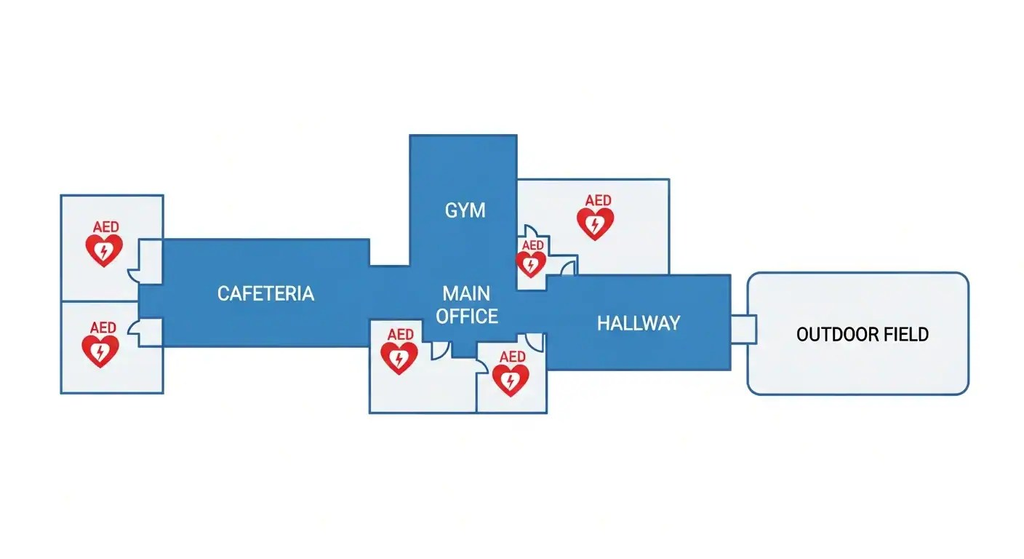
Upon officially joining the project, Emma’s primary focus became updating AED location data. Volunteers were tasked with documenting the exact location of each AED based on building names, floor numbers, entrance directions, and nearby landmarks, while refining confusing descriptions into clear instructions. For example, vague descriptions like “1st Floor, Gymnasium” were updated by the team to “Gymnasium Main Entrance, right hallway past the entrance, next to the equipment room door”; similarly, “Near the Library” was refined to “Library East Entrance, inside next to the service desk.”
While these text descriptions may appear mundane, they are essential in critical moments. Under emergency conditions, people struggle to analyze routes calmly; if a location description is ambiguous, valuable time is lost searching back and forth. Emma worked with her team to test routes on-site, starting from various building entrances to estimate travel times to the nearest AED and identifying where supplementary directional arrows or explanatory placards were required.
During one inspection, she noticed that an AED cabinet’s instructional sticker had faded and the emergency contact number was insufficiently prominent. Rather than simply archiving a photo of the issue, Emma documented it in the feedback report and assisted the team in producing new, simplified prompt cards. The cards retained only the most vital actions: Stay Calm, Call Emergency Services Immediately, Dispatch Someone to Retrieve the AED, Follow the Voice Prompts on the Device, and Wait for Professional Responders to Arrive. Emma understood that volunteers cannot replace professional paramedics, nor can complex medical judgments be reduced to simple slogans. However, by providing clear directions, precise locations, and orderly on-site coordination, volunteers can help bystanders feel less panicked and more directed when unexpected emergencies occur.
03 Inspiring Confidence in First Aid Support: From Event Venues to Volunteer Training
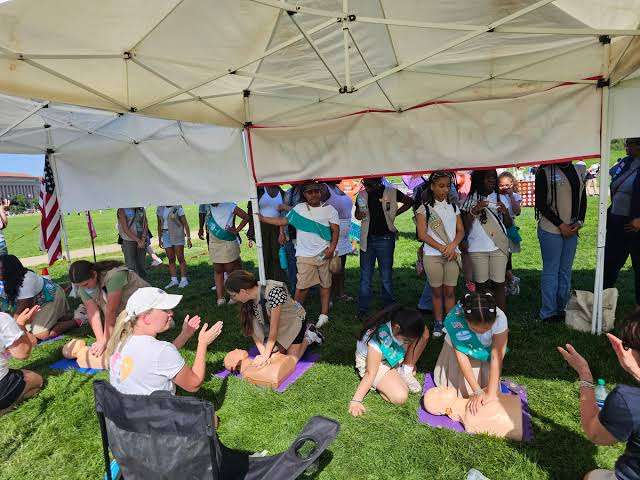
With growing experience, Emma began assisting with safety support at public events. At campus sports days, charity walks, and university open days, large crowds and complex event routes require volunteers to pre-confirm emergency stations, assembly points, supply posts, and emergency contact methods. During one charity sports event, Emma was responsible for guiding new volunteers through emergency protocols. She noticed that many newcomers felt anxious at the mention of “first aid support,” worrying that their lack of a medical background might lead to mistakes during a real incident. Emma broke the training content down into specific, actionable steps: a volunteer’s primary duty is to identify anomalies promptly, call for professional medical help, maintain crowd order, and guide the retrieval of an AED—rather than attempting medical procedures beyond their training.
She also reminded the team that communication in high-pressure situations must be concise and direct. Instead of repeatedly shouting “hurry up,” it is far more effective to assign explicit tasks: “You, call emergency services,” “You, fetch the AED,” “You, wait at the entrance to guide the ambulance,” and “You, help move the crowd back.” These clear instructions quickly bring structure to a chaotic scene.
Following a training session, a new volunteer shared with Emma that they had always viewed AEDs as distant from daily life, but now realized that ordinary people play an indispensable role in the chain of survival. Emma found this feedback deeply meaningful. To her, public first aid initiatives are not about instilling fear, but about empowering people to do the right, timely thing when help is genuinely needed.

04 Demonstrating Public Safety Commitment Through Sustained Service
Throughout her journey with the ICSO UK Branch, Emma steadily progressed from an entry-level volunteer to a key youth leader assisting with location inspections and new volunteer onboarding. Prior to events, she meticulously verifies AED location records, emergency prompt cards, and event route maps; during events, she reminds volunteers to familiarize themselves with the nearest first aid points and assembly areas; and post-event, she consolidates feedback on signs needing updates, route descriptions requiring clarification, and training modules that need enrichment.
According to official ICSO system records, over the past year and a half, Emma has completed over 20 volunteer service activities with the ICSO UK Branch. Her efforts encompass AED location inspections, public first aid support, emergency guidance material preparation, event safety assistance, volunteer training support, and project feedback archiving—accumulating more than 175 hours of voluntary service. In recognition of her sustained dedication and exemplary performance, she was awarded the title of ICSO Three-Star Youth Volunteer and received the official ICSO Volunteer Service Certificate.
Emma reflects that she previously viewed public welfare primarily as directly assisting individuals with immediate difficulties. Through her project involvement, she gradually realized that some forms of public welfare happen behind the scenes through advance preparation. Most of the time, an AED cabinet may never be opened, and emergency procedures may never be triggered. Yet, should the day come when they are needed, every past inspection, every updated sign, and every training session becomes vital. The value of an AED lies not only in the physical device itself, but in whether it can be located swiftly, retrieved correctly, and integrated seamlessly into emergency rescue efforts. May more youth volunteers follow Emma Clarke’s example—transforming routine inspections, location logs, and dedicated training sessions into daily emergency preparedness, ensuring public safety is safeguarded in every corner of our communities.